

4S prepares a written risk assessment for your machine, as required by the Machinery Directive 2006/42/EC – and, from 20 January 2027, by the Machinery Regulation (EU) 2023/1230 – for every manufacturer of a machine. It forms the basis for CE marking and is a mandatory part of the technical documentation.
Annex III Part B No. 1 of the Machinery Regulation states:
“The manufacturer of machinery or related products shall ensure that a risk assessment is carried out in order to determine the essential health and safety requirements which apply to the machinery or related product. The machinery or related product shall then be designed and constructed taking into account the results of the risk assessment.” The Machinery Directive sets out the same duty in Annex I: the task does not change, but the requirements to be determined do.
Who is affected
Becoming a manufacturer is not limited to building a new machine. Anyone who modifies or extends an existing machine can thereby become a manufacturer themselves – with the same obligation to carry out a risk assessment. From the deadline onwards this applies expressly to every substantial modification: if the modification creates a new hazard or increases an existing risk so that a protective measure involving the safety control system becomes necessary, the modifier becomes the manufacturer. Whether that is the case for you is settled in advance by a modification assessment. The same requirement applies to manufacturers of partly completed machinery.
Machinery Risk Assessment: What It Covers
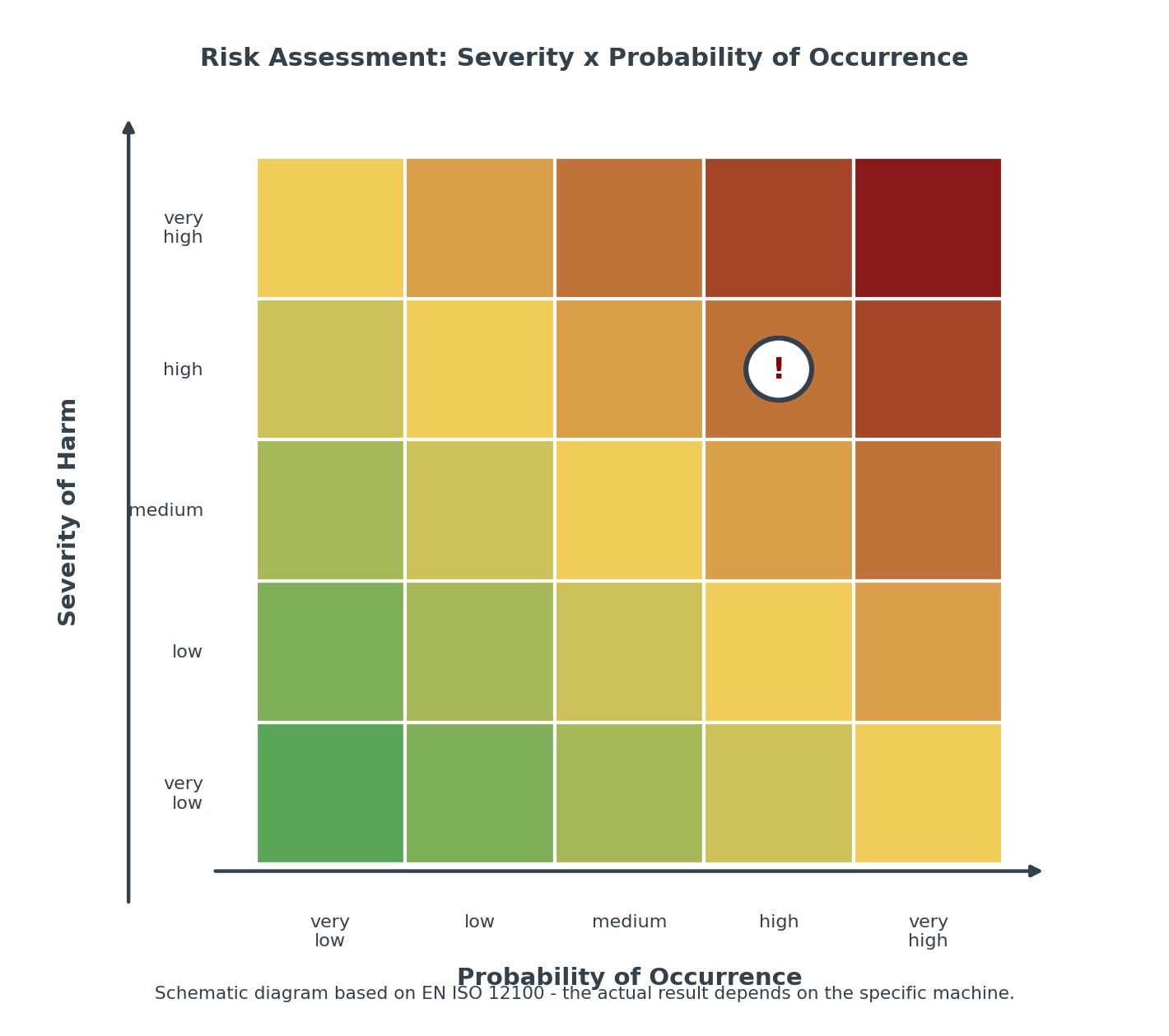
The risk assessment is based on the harmonised standard EN ISO 12100 (Safety of machinery – General principles for design – Risk assessment and risk reduction. The hazards of the machine are systematically identified across its entire life cycle, the resulting risk is evaluated, and protective measures are derived in the order of priority set out in the standard: first by inherently safe design, then by technical measures, and finally through information for use.
EN ISO 12100 is harmonised under the Machinery Directive, where applying it confers presumption of conformity. The list of harmonised standards under the Machinery Regulation is only being built up. Which standards confer presumption of conformity for your machine, and where conformity has to be argued without them, we therefore check project by project.
Process
- You send me the available documentation on the machine – design data, drawings, circuit diagrams, and, for modifications, the existing instructions for use and any earlier risk assessment.
- The hazards are identified from the documentation and, once the machine is assembled, on site.
- You receive the written risk assessment according to EN ISO 12100, listing all identified hazards, their evaluation, and the derived protective measures.
- A joint follow-up discussion to agree on the safety measures that are practically implementable for your project.
What you end up with
A complete, traceably documented risk assessment that you use as part of your technical documentation – the basis for the instructions for use, for the EU declaration of conformity that you issue as the manufacturer, and for a further safety concept.
What changes with the Machinery Regulation
- The essential health and safety requirements are set out in Annex III of the Regulation – broader in substance than Annex I of the Directive.
- Protection of safety functions against corruption and the handling of software changes are requirements in their own right and belong in the assessment.
- Machinery with evolving behaviour and machinery operating autonomously are expressly covered – including hazards that only arise from that behaviour in service.
- Interactions between linked machines that function as an assembly are part of the assessment.
- The instructions may be provided digitally – subject to conditions, and on paper on request.
Where your company stands overall is shown by the MVO readiness check; the self-test there gives a first indication in six questions.
In addition
Whether a protective device provides sufficient distance from the hazard zone can already be worked out and documented in advance with the free online calculators according to EN ISO 13855 and EN ISO 13857.
Not sure whether your modification makes you a manufacturer and therefore requires a risk assessment? CONTACT 4S – I will help you clarify the requirements under the applicable regulation.
Are you delivering machinery into German-speaking markets (Germany, Austria, Switzerland)? 4S can also act as your German-speaking point of contact on site and support the entire project from a safety-engineering perspective. Technical documents are prepared directly in German or English; a Spanish or Swedish version is translated on request.