
On 20 January 2027, the Machinery Regulation (EU) 2023/1230 replaces the Machinery Directive 2006/42/EC. For products placed on the market for the first time from that date onwards, there is no transition period. Anyone who has not made the switch by then may not supply.
The MVO Readiness Check answers, in a single appointment, the question every machine manufacturer is currently asking: What do we need to do before the deadline to keep placing our machines on the market in compliance with the law?
Machinery Regulation 2027: Why This Is Urgent Now
- No transition period. What matters is the date the product is placed on the market, not the date the order was received. Machines with long production times are already affected today.
- New requirements are being added. Protection against corruption, handling of software updates and self-evolving behaviour, digital instructions for use, substantial modification.
- The harmonised standards are only emerging gradually. Until then, compliance must be demonstrated without the presumption of conformity – which takes time.
What is checked
The basis is a structured checklist covering eight areas. Each requirement is assessed as met, partially met, open or not applicable, and backed up with the relevant reference in the Regulation.
The areas checked cover both the technical documentation and the further new requirements of the Machinery Regulation, including protection against corruption, software and self-evolving behaviour.
Are you ready for the Machinery Regulation?
Six questions, no contact details, result straight away. The test shows you where you are likely to still have work ahead of 20 January 2027.
How things really stand at your company is what the readiness check shows – the procedure is set out right below. Request an appointment.
The test runs entirely in your browser. No entries are transmitted or stored.
Process
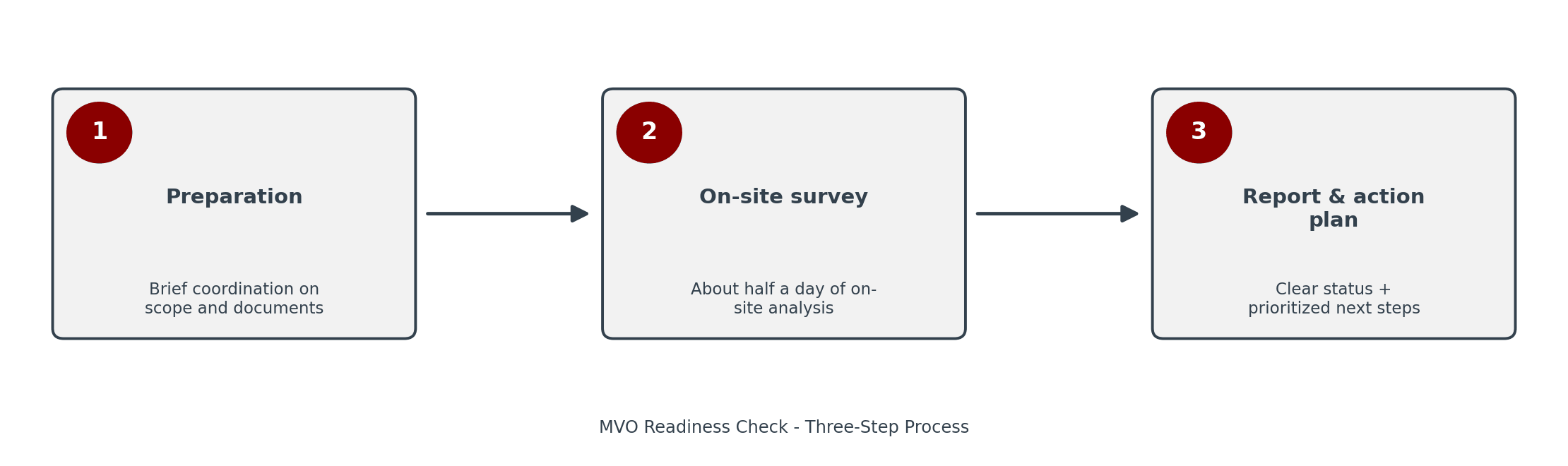
1 · Preparation
Beforehand, please send me one example each of a risk assessment, instructions for use and a declaration of conformity, along with a list of your product series. I review the documents before I arrive – this saves a lot of time on site.
2 · On-site assessment, around half a day
We go through the checklist together – with those responsible for design, technical documentation and, where relevant, sales.
3 · Report and action plan
You receive a written report with the completed checklist, an overview per area, and an action plan with priorities, responsibilities and deadlines up to the cut-off date.
What you end up with
- A solid answer to the question of whether you will be able to supply by the deadline
- The completed checklist with references in the Regulation – traceable for management, customers and authorities
- A prioritised action plan with deadlines, rather than a general recommendation
- Clarity on what you can do yourself and where you need support
Who the check is for
For machine manufacturers, manufacturers of partly completed machinery and safety components, as well as authorised representatives, importers and distributors placing products on the market after 19 January 2027. The check is especially worthwhile if your risk assessment and instructions-for-use templates still refer to the Machinery Directive, or if no one in your company can say whether one of your products falls under Annex I Part A.
What the check is not
It replaces neither a risk assessment nor the conformity assessment of individual machines. It assesses the technical and documentary status of your company and provides the basis for planning the transition.
Arrange an appointment
Only a few planning cycles remain before 20 January 2027. The sooner the need for action is clear, the calmer it can be worked through – and the sooner you can get an appointment with a notified body, should you need one.
Write to me briefly about what products you manufacture and where you currently stand. You will receive a reply with a proposed appointment and a quote within two working days.
You can reach me by phone or email:
4S…4Safety!
Are you delivering machinery into German-speaking markets (Germany, Austria, Switzerland)? 4S can also act as your German-speaking point of contact on site and support the entire project from a safety-engineering perspective. Technical documents are prepared directly in German or English; a Spanish or Swedish version is translated on request.