Flap gates, sluice gates, stoplogs, bottom outlets and rake cleaning machines are machinery in the legal sense: moving steel components with a hydraulic or spindle drive and a control system that is frequently operated remotely from the control room. In hydropower the occasion is called refurbishment, in flood protection it is called upgrading – technically and legally it is the same subject. 4S supports power plant operators, industrial companies with their own hydropower and hydraulic steel contractors in achieving CE conformity for their installations, and has made this field one of its focus areas in machinery safety.
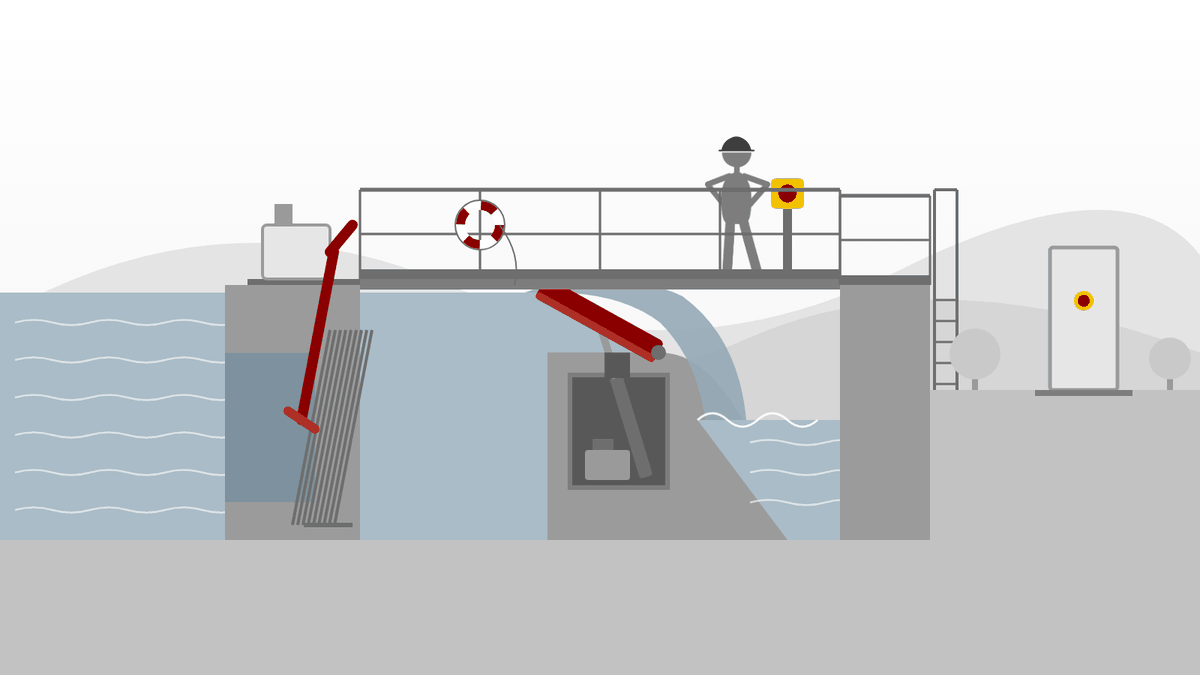
Why a weir installation is machinery – and who becomes its manufacturer
The hydraulic steel contractor usually supplies the gate as partly completed machinery with a declaration of incorporation, the hydraulic power unit comes from the hydraulics manufacturer, the electrical installation from the electrical contractor under the Low Voltage Directive, the structural calculation from the civil engineer. Everyone delivers correctly – and in the end the conformity assessment for the assembly is missing, because nobody has taken on the role of the manufacturer. This is exactly where we come in: we bring the declarations of incorporation and partial documentation together in a risk assessment of the interfaces, name the open requirements and prepare the documentation for the CE conformity assessment under the Machinery Directive, and from 20/01/2027 the Machinery Regulation (EU) 2023/1230. A water rights permit does not replace this evidence – and vice versa.
Refurbishment and upgrading: Article 18 of the Machinery Regulation
A flap gate from the 1970s gets a new hydraulic cylinder, a new control system and will in future be operated remotely from the control room. From 20/01/2027 the rule is: whoever substantially modifies machinery becomes its manufacturer – with risk assessment, technical documentation, conformity assessment and CE marking. The threshold is reached as soon as the change creates a new hazard or increases an existing risk, and a protective measure involving the safety control system therefore becomes necessary. For a gate that will move without line of sight, that is quickly the case. Whoever clarifies this before the modification with a modification assessment decides the scope themselves; whoever clarifies it afterwards is discussing it with an authority or an insurer.
Typical hazards at weirs and gates
- Crushing and shearing points at the gate during remote operation and unexpected start-up – people in the weir bay, at the trash rack or in the shaft cannot be seen from the control room.
- Hydraulics: stored energy, leakage, oil in the water body, emergency lowering on power failure (EN ISO 4413).
- Access: ladders, platforms and stairs to EN ISO 14122, anchor points to EN 795, rescue of people from the water and from the structure.
- Flooding of the structure and power failure: emergency drive, manual operation, safe state of the gate.
- Ice, driftwood and weather affecting sensors, limit switches and cameras outdoors.
- Remote access and control: protection against manipulation and unauthorised access, as expressly required by the Machinery Regulation.
Standards and rules
EN ISO 12100 for the risk assessment, EN ISO 13849-1 for the performance level of the safety functions (emergency stop, end position monitoring where applicable, enabling), EN ISO 4413 for hydraulics, EN 60204-1 for the electrical equipment, EN ISO 14122 for access, EN 795 for anchor points, and the Low Voltage and EMC Directives for the electrical parts of the installation. Which standards are harmonised standards and therefore confer presumption of conformity we check project by project.
Examples from our projects
- Several power plant installations: risk assessment of the interfaces between turbine, control technology and hydraulic steelwork, CE assessment and support during modifications.
- Newly built weir installation: fish pass, stoplogs, gate with flap and flap gate – the declarations of incorporation from steelwork, hydraulics and electrical installation brought together in a CE conformity assessment, including operating instructions, performance level evidence and validation.
- Weir installation with flap gate, slide gates and Coanda screen: complete CE documentation for the operator.
- Flood protection gate for the manufacturer: risk assessment, addition to the operating instructions, performance level, validation and CE conformity assessment as a package accompanying the gate.
Our services for hydraulic steel structures
For operators: risk assessment of the whole installation and its interfaces, CE conformity assessment bringing together all supplier documents, modification assessment before refurbishment, validation before commissioning and hazard analysis for existing equipment. For hydraulic steel contractors: the complete CE package per gate – you build, we document – so that the CE marking you owe your clients is backed up in your quotation. For the scope see package CE conformity complete and package modification assessment.
Are you planning an installation, facing a modification, or missing the conformity assessment? Talk to us – after a short conversation we will tell you which route is the right one for your project.