
Industrial robots, collaborative applications with so-called cobots, gantry robots and mobile robots are at the core of automation in many plants – and in almost every project they are the part with the most open safety questions. For many years 4S has supported integrators and operators in safeguarding robot cells: from the risk assessment and the safety concept through to CE marking of the finished installation. Robot applications are one of our focus areas in machinery safety.
From robot to robot cell: who is the manufacturer?
A robot is supplied by the robot manufacturer as partly completed machinery – with a declaration of incorporation. It does carry a CE marking, but not under the Machinery Directive or Machinery Regulation; usually it is marked under the Low Voltage and EMC Directives. It only becomes machinery through integration: gripper, feeding system, guard fence, light curtains, safety control system and program. Whoever brings these parts together into a robot cell is the manufacturer of that cell and has to demonstrate conformity with the Machinery Directive, and from 20/01/2027 the Machinery Regulation (EU) 2023/1230. This applies to the system integrator just as much as to an operator who installs a robot into an existing line – in that case as a modification of existing machinery.
Typical hazards and measures in robot cells
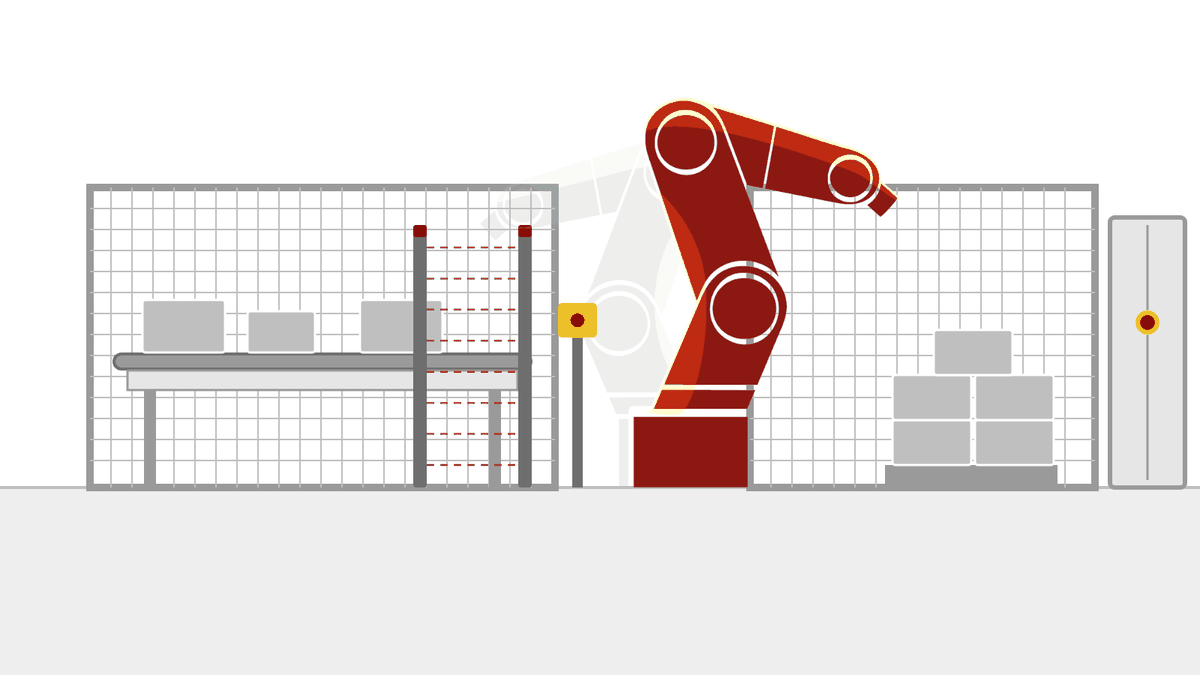
- Access to the working area: fixed guards to EN ISO 14120 with the safety distances of EN ISO 13857, interlocking guards with or without guard locking to EN ISO 14119.
- Material transfers without a fence: light curtains and laser scanners with a correctly calculated minimum distance to EN ISO 13855, including muting at infeed and outfeed points.
- Presence behind the robot and unexpected restart: presence detection, acknowledgement from outside the cell, start enable only when the working area is clear.
- Setting up and teaching inside the cell: safely reduced speed, enabling device, mode selection with defined access rights.
- Gripper and workpiece: loss of vacuum, falling parts, sharp edges, trapping points at the gripper itself and the workpiece – often the actual hazard in collaborative applications.
- Additional axes, linear gantries and turntables that the robot manufacturer has not safeguarded.
Collaborative applications: no fence does not mean no evidence
Collaborative robots are often sold as being “inherently safe”. Yet it is never the robot that is safe, it is always the application: gripper, workpiece, speed and the body regions that can be reached decide whether the permissible force and pressure values are met. The current EN ISO 10218-2 has adopted the limit values previously given in ISO/TS 15066 and requires evidence for every type of collaboration. We examine your cobot application, define the measurements required and document the result so that it stands up to scrutiny by authorities or insurers. For mobile platforms carrying a robot, EN ISO 3691-4 for driverless systems applies as well.
Standards we work with
EN ISO 10218-1 and -2 for robots and robot cells, EN ISO 12100 for the risk assessment, EN ISO 13849-1 for the performance level of the safety functions (emergency stop, guard monitoring, safely reduced speed, safe zones), EN ISO 13855 and EN ISO 13857 for protective devices and distances, EN ISO 14119 and EN ISO 14120 for interlocks and guards, EN ISO 3691-4 for driverless industrial trucks and mobile robots. We check the list of harmonised standards for every project.
Examples from our projects
- Palletising robot with vacuum gripper: transfer from the conveyor into customer-supplied rack trolleys – interfaces to the existing equipment defined, cell CE-assessed as an assembly.
- Robot on a linear axis separating parcels between two existing conveyor lines: risk assessment, safeguarding concept with material locks, performance level evidence.
- Mobile cobot feeding a processing machine: assessment of the type of collaboration, delineation from the customer’s machine with its own CE conformity.
- Robot welding cells: safeguarding of welding cells with turntable and operator loading station – guard fence, light curtain, glare protection and extraction taken into account in the safety concept.
- Robot training cells for training institutions and robot manufacturers: realised several times, including extensions during operation.
- Reassessment of existing robot cells in the course of modifications.
Our services for robot applications
Risk assessment of the robot cell, safety concept defining protective devices and operating modes, performance level calculation to EN ISO 13849-1 for all safety functions, validation before commissioning including verification of the safety distances, technical documentation and CE conformity assessment – as a complete package or as project support for your integrator. Robot applications are also a dedicated topic in our workshops.
Are you planning an installation, facing a modification, or missing the conformity assessment? Talk to us – after a short conversation we will tell you which route is the right one for your project.