Roller conveyors, belt and chain conveyors, pallet handling, vertical conveyors, turntables, connections to high-bay warehouses and driverless transport systems: conveyor technology links machines into lines – and turns individually CE-marked machines into an assembly for which someone has to take responsibility. 4S has supported a large number of linked installations, from a small pallet line to a multi-stage production line. Conveyor technology is one of our focus areas in machinery safety.
Linked installations: the assembly of machinery
As soon as conveyors, labellers, packaging machines or palletisers are connected by their control systems so that they function as a whole, an assembly of machinery arises within the meaning of the Machinery Directive, and from 20/01/2027 the Machinery Regulation (EU) 2023/1230. The CE marking of the individual machines remains valid – but the interfaces between them, the common emergency stop structure and access to the line have to be assessed by whoever creates the link. In practice this is often the operator or a plant builder supplying the conveyor technology. Where existing machines are reused, the modification assessment is added.
Typical hazards in conveyor technology
- Drawing-in points between belt and drum, at deflections, drive rollers and chain wheels – the classic conveyor hazard, often at inconspicuous places.
- Crushing and shearing points at transfers, lifting and lowering stations, turntables, diverters and stops.
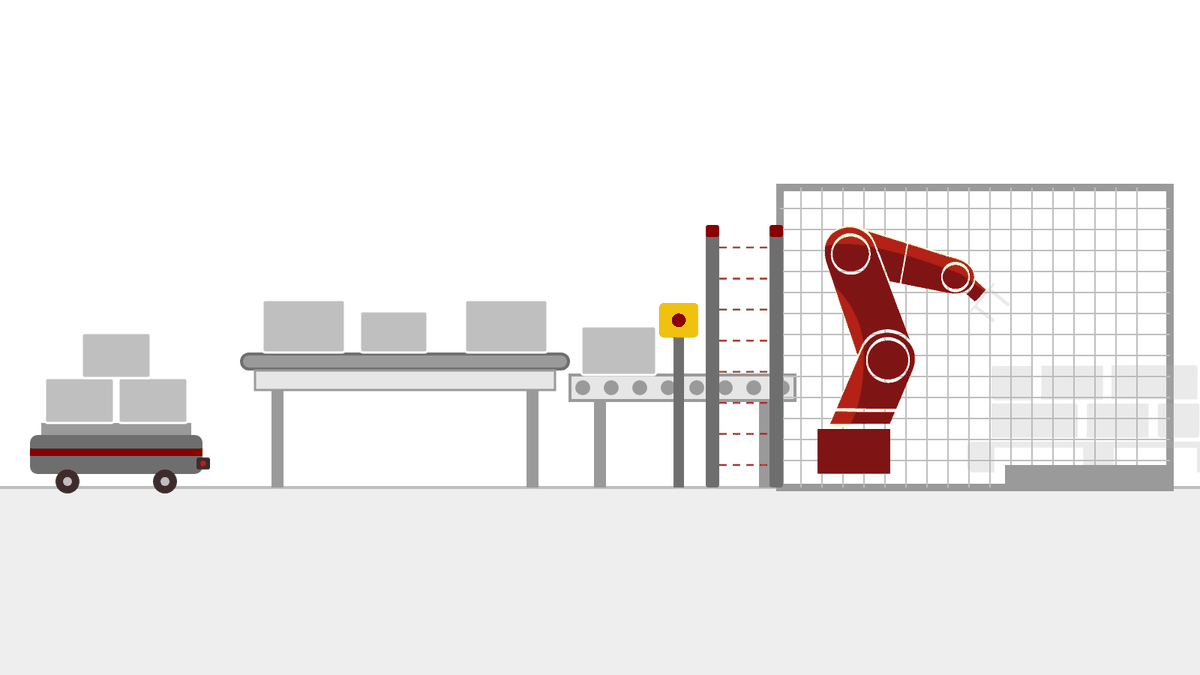
- Access to automated areas: palletisers, storage zones, transfer stations to stacker cranes or AGVs – guard fence, interlocked doors with guard locking and material locks with muting.
- Long conveyor runs: reachability of emergency stop devices, pull-wire switches, restart after clearing jams and cleaning.
- Climbing onto the conveyor as reasonably foreseeable misuse – the most frequent cause of accidents during faults.
- Fault clearance during operation: operating modes, inching, line of sight to the hazard zone.
Standards we work with
EN 619 (continuous handling equipment for unit loads), EN 620 for belt conveyors for bulk materials, EN 617 and EN 618 for storage and transfer of bulk materials, EN 528 for stacker cranes, EN ISO 3691-4 for driverless industrial trucks, EN ISO 13857 for the safety distances at fences and openings, EN ISO 13855 for light curtains and muting, EN ISO 14119 and EN ISO 14120 for interlocked doors and guards, and EN ISO 13849-1 for the performance level of the safety functions. We check the status of the harmonised standards for every project.
Examples from our projects
- Extension of an existing pallet conveyor system with turntable, roller conveyor and labeller: delineation of the purchased machines, risk assessment of the new assembly.
- Gantry robot palletising store with transfer by automated guided vehicles: guard fence, interlocked doors with guard locking, transfer station as a material lock.
- Strip line in metal processing with decoiler, straightener and press from the existing plant and a new overall control system: modification assessment and CE conformity of the assembly.
- Workpiece carrier separation units and assembly lines in vehicle production.
- Cutting and converting lines with connected conveyor technology, and connection of production lines to a high-bay warehouse.
Our services for conveyor technology
Risk assessment of the assembly and its interfaces, safety concept with emergency stop structure, protected zones and operating modes, performance level calculation of the safety functions, validation before commissioning, documentation and CE conformity assessment – for new installations as a complete package, for extensions and linking of existing equipment as the modification assessment package. Conveyor technology is also a topic in our workshops.
Are you planning an installation, facing a modification, or missing the conformity assessment? Talk to us – after a short conversation we will tell you which route is the right one for your project.